Local Link Building: Earning Links That Actually Change Local Rankings
Local link building has a credibility problem, and it is mostly self inflicted. The advice tends to be a list of tactics with no way to judge which ones are worth doing for a particular business. Sponsor a little league team. Join the chamber. Write a guest post. Some of that works. Some of it produces a link that changes nothing.
The useful question is not "what tactics exist." It is "which of the links available to this specific business are worth the effort, and where should they point."
That is what this covers.
Links and citations are different assets, and mixing them up wastes money
A citation is a structured listing of your name, address, and phone number on a directory. Its job is consistency. It confirms to search engines that the business details you claim are the same details everyone else has.
A link is an editorial vote. Its job is authority transfer. Someone chose to point at you from within their own content.
Some directories give you both. Most give you one. The trap is treating a citation cleanup project as a link building programme, or paying for 200 directory submissions and expecting movement in the local pack.
Here is the split that matters in practice. Citations behave like a floor. Once your listings across the main platforms and data aggregators are accurate and consistent, additional citations produce diminishing returns fast. Links behave like a ceiling. There is no natural point at which more good local links stop helping.
The 2026 Whitespark Local Search Ranking Factors survey, which polls a large panel of local SEO practitioners, puts link signals well ahead of citation signals in both local pack and local organic results, with the gap widest in local organic. That matches what I see. If a business is stuck in local organic while the profile itself is healthy, links are usually the constraint. If it is stuck in the pack specifically, the profile and reviews are usually the constraint first, and links come after.
So do the citation work. Just do it once, do it properly, and then stop. Structured directory listings and NAP consistency are foundation work, not growth work.
Why national link tactics fail for local businesses
The standard link building playbook assumes a content asset that anyone anywhere might want to link to. A statistics roundup. An industry survey. A free tool.
A plumber in Leeds does not have that, and building one is usually a bad use of budget. Worse, if it works, the links come from national domains with no geographic connection, which is the least useful kind of link for a business whose entire market sits inside a twenty mile radius.
Local link building runs on a different logic. You are not trying to prove the business is authoritative in general. You are trying to prove it is a real, active participant in a specific place. Those are different proofs, and they come from different sources.
The good news is that local businesses have a link surface that national brands do not: they exist physically, they buy from local suppliers, they hire local people, they hold licences, and they show up at things. Every one of those is a potential link, and most of them are already happening.
The Local Link Value Grid
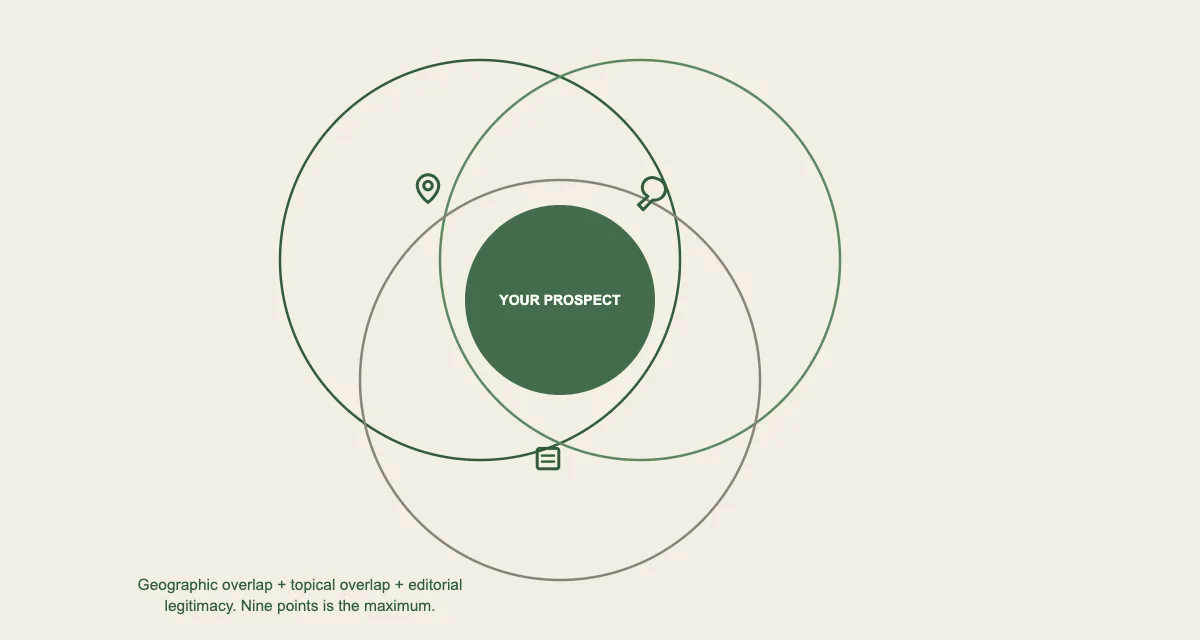
Before contacting anyone, score the prospect on three axes. One to three points each. Nine is the maximum.
Geographic overlap. Does this site's audience live where your customers live?
- 3: serves your city or region specifically
- 2: serves your wider county, state, or metro area
- 1: national or global audience
Topical overlap. Does this site cover subjects connected to what you sell?
- 3: your industry or an adjacent trade
- 2: a broad category that includes you (business, home, health, family)
- 1: unrelated
Editorial legitimacy. Would a link from here exist if search engines did not?
- 3: a real publication, association, institution, or organisation with its own audience
- 2: a legitimate site with a low bar for outbound links
- 1: exists mainly to sell links
Add them up.
- 7 to 9: pursue actively. This is where your effort belongs.
- 5 to 6: pursue if it is cheap or fast, or if it comes with something other than the link (referrals, credibility, a relationship).
- Below 5: skip. The exception is a legitimate national industry association, which scores low on geography but carries trust that is worth having.
Any prospect scoring 1 on editorial legitimacy is a no regardless of the other two scores. Paying specifically to pass ranking credit is against Google's link spam policies, and the sites that sell those links are exactly the ones that get devalued in bulk.
This grid changes decisions. A regional trade body scores 3, 3, 3. A national blog in your industry scores 1, 3, 3. A local lifestyle site scores 3, 2, 2. A directory that lists every plumber in every postcode scores 3, 3, 1 and is therefore a no.
Source prospects from operations, not from tools
This is the part that separates local link building that works from local link building that stalls.
Most people open a backlink tool, pull a competitor's profile, and start emailing strangers. That produces a low reply rate because there is no existing relationship and no reason to say yes.
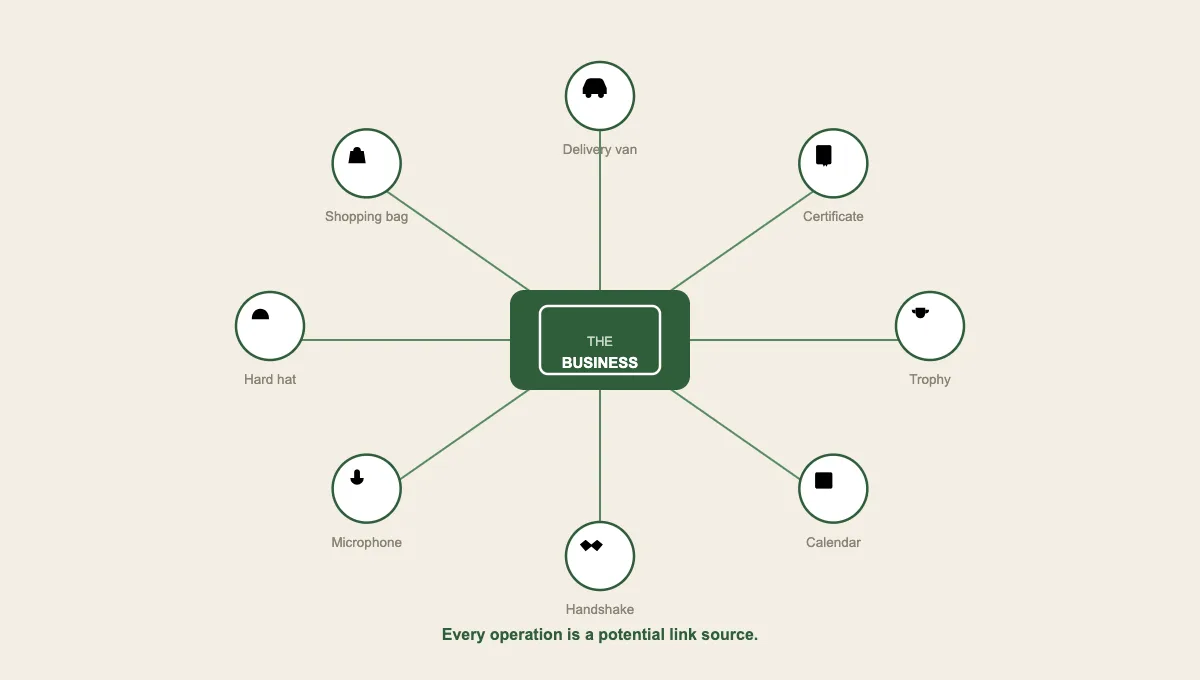
Instead, start with a conversation with the business owner. Ask these questions and write down every answer:
- Who do you buy from? Suppliers and manufacturers often have dealer, stockist, or installer directories.
- What are you certified or licensed by? Certification bodies list holders. So do insurers and warranty providers.
- What do you sponsor, or what have you been asked to sponsor? Teams, school events, community groups, local festivals.
- What associations, chambers, or trade groups are you a member of? Membership usually includes a listing.
- Where do you advertise offline? Local publications almost always have an online arm.
- Who have you partnered with on a job? Architects, contractors, agencies, and complementary trades run project pages and case studies.
- Have you ever been quoted in a local paper, radio show, or podcast?
- Do you host, teach, or speak anywhere?
- Do you hire apprentices or work with a college or training provider?
- Do you have data nobody else has? Job volumes, seasonal patterns, price changes, common failure causes in local housing stock.
That list typically produces fifteen to thirty real prospects in an hour, most of which score 7 or higher on the grid, and most of which involve a relationship that already exists. Asking a supplier to add you to their installer directory is not outreach. It is admin.
The last item on that list is the one businesses undervalue. A heating engineer who has serviced 900 boilers in the same city knows things a journalist would find genuinely interesting: which boiler models fail most in local housing, what a typical repair costs this year versus last, when the first cold snap call outs start. That is original first party data, and it is the most reliable route into local press coverage that I know of. It is also the one thing a competitor cannot copy.
Unlinked mentions are the cheapest wins available
Search your business name in quotation marks, plus the owner's name, plus any product or service names unique to you. Filter out your own properties.
You will find mentions in local news, forum threads, event listings, supplier pages, and blog posts where someone wrote your name without linking. Each one is a person who already decided you were worth mentioning. Asking them to make it a link has a far higher success rate than cold outreach, because the editorial decision is already made.
Do this once a quarter. It takes twenty minutes and it consistently produces two or three links a business would otherwise never have.
Where the links should point
This gets handled badly almost everywhere. Most local links land on the homepage by default, because that is what people paste into a form.
That is fine for brand mentions and directory entries. It is a wasted opportunity for editorial links.
A rough allocation that works:
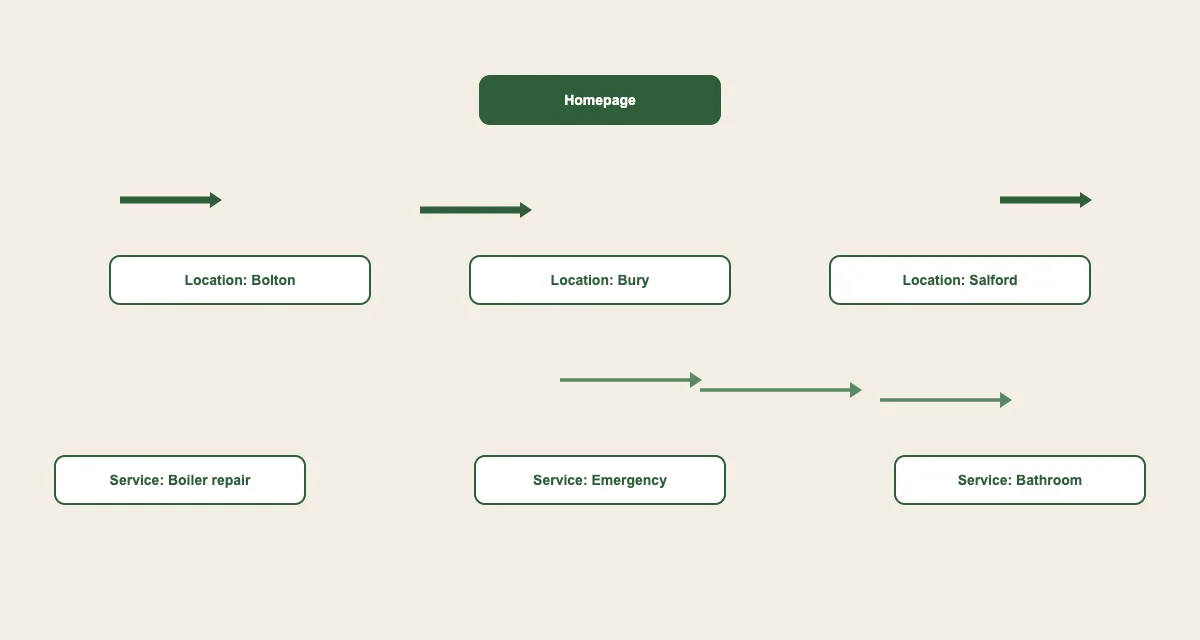
- Homepage: membership listings, chamber entries, sponsorship credits, and anything where the mention is about the business as a whole.
- Location pages: press coverage tied to a specific area, sponsorships of a specific local team or venue, and partnerships with organisations rooted in one place. If you have built the location pages these links should point to properly, they are the strongest destination for anything geographically specific.
- Service pages: supplier and manufacturer directories where the listing is about a particular product or specialism, certification body listings, and case studies about a specific type of work.
- Resource or data pages: press links earned with original data should point at the page containing the data, not the homepage.
One caution. A location page that only exists to catch links, with no genuine content behind it, will not hold the value you send to it. The page has to be worth landing on.
Anchor text in a local context
Keep it natural and mostly branded. In real editorial writing, people link on business names, on descriptive phrases, and on generic text like "their website."
Exact match commercial anchors ("emergency plumber Leeds") occurring repeatedly across links you influenced is a pattern, and it is a pattern that is easy to detect. If a site offers to let you choose the anchor text, that itself tells you something about the site's editorial legitimacy score.
Where you have any say, prefer:
- The business name
- The business name plus a descriptor ("Riverside Plumbing, a heating firm in south Manchester")
- A natural phrase from the sentence
That is what unpaid links look like, so that is what your influenced links should look like too.
How to tell whether it is working
Do not measure local link building by link count. Measure it by referring domains, and specifically by referring domains that score 7 or higher on the grid.
Competitive benchmarks vary enormously by market. Top ranking pages in low competition local markets often sit under 25 referring domains, while competitive legal or medical markets in large cities run into the hundreds. Check the actual pages ranking for your target query rather than working from an average, because the average is meaningless across that spread.
Then track position, not traffic, in the early months. Local organic movement from links tends to show up as a slow drift up the page before it shows up in the traffic report, and if you are only watching sessions you will conclude nothing is happening for a quarter.
If links are going in and nothing moves at all, links may not be your constraint. Diagnosing which signal is actually holding you back before spending three months on outreach is worth the afternoon it costs.
Local link building rewards businesses that are genuinely part of their area, and it is slow for everyone else. If you would rather not spend six months finding that out, I map the reachable link surface for a business first, then work the prospects that are actually worth the time. You can see how I approach it at rohanalvi.com.
Frequently Asked Questions
Are local backlinks more valuable than citations? For local organic rankings, clearly yes. For local pack position, the gap is smaller and profile factors plus reviews usually matter more. The practical answer is to complete citation work once, keep it accurate, and put ongoing effort into links.
How many local backlinks do I need? Check the pages currently ranking for your target query and count their referring domains. That number varies from under 25 in low competition markets to several hundred in competitive city legal and medical markets. There is no universal target.
Do chamber of commerce links still work? They do, and they score well on the grid because they combine geographic relevance with an organisation that has a real reason to exist. Just do not treat one chamber listing as a link building strategy. It is one prospect out of twenty.
Is it against Google's guidelines to pay for a sponsorship link? Sponsoring a real organisation and being credited on their supporters page is normal business activity. Paying a website specifically so that it passes ranking credit is against the link spam policies. The difference is whether you are buying the sponsorship or buying the link.
Should all my local links point to the homepage? No. Send geographically specific links to the relevant location page, product and specialism links to the matching service page, and general brand mentions to the homepage. Just make sure the destination page is genuinely worth landing on.
How long before local link building shows results? Expect movement in local organic positions over two to four months of consistent work, with the first visible change usually being position drift rather than a traffic jump. Local pack movement from links alone is slower and less reliable.