
Google Reviews and Local SEO: The Parts That Actually Move Visibility
Most advice about reviews stops at the star rating. Get to 4.5. Get more than the competitor. Reply nicely.
That advice is not wrong, but it misses the part of a review that does the most work. The star rating is a single number attached to a profile. The review text is a body of customer written language describing what your business does, where it does it, and how well. Those two things get used very differently.
Here is a pattern I run into constantly. A business has 180 reviews at 4.8 stars and still cannot rank for its second and third most profitable services. Read the reviews and the reason is sitting there: 170 of them describe the same one service. Nobody has ever written the words that match the other two.
Review text is a customer written attribute index
Think of your review corpus as a second description of your business, written by other people, that you do not control and cannot edit. That lack of control is exactly what gives it weight.
When a customer writes "they replaced our boiler in Didsbury on a Sunday," that sentence contains a service, a location, and a service condition. When another writes "the emergency call out was here in under an hour," that is a different attribute again. Over hundreds of reviews, this builds a picture of what your business actually does, in language real people use, tied to real places.
This is why I run a review attribute coverage check on every account I take over. It takes about twenty minutes.
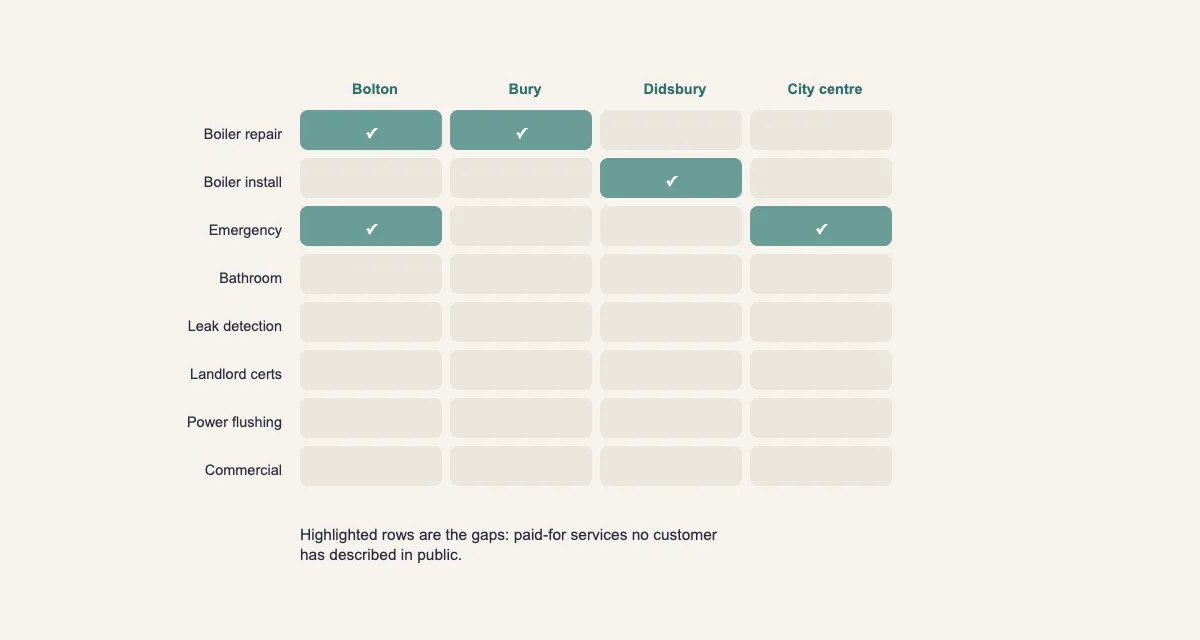
- List every service you sell and every area you serve. Put them in a spreadsheet as rows.
- Export or copy your review text into a document.
- Search the review text for each service term and each place name. Count the matches.
- Highlight every row with a count of zero or one.
Those highlighted rows are your gaps. They are services you are paid for that no customer has ever described in public. In practice, those are almost always the services you struggle to rank for and the ones that never surface when someone asks an AI assistant for a recommendation.
The fix is not to tell customers what to write, which is now explicitly against policy and covered below. The fix is to change *who you ask and when*. If you finish twelve commercial jobs a month and only ever send review requests after residential jobs, your review corpus will never describe commercial work. That is a process problem, not a wording problem.
Recency has become one of the sharpest signals
Volume gets the attention, but recency is doing more work than it used to.
The 2026 Whitespark Local Search Ranking Factors survey moved review recency dramatically up its ranked list of factors, one of the largest positional jumps in that study's history. That matches what I see in the field. A profile with 400 reviews where the newest is nine months old behaves like a business that may have closed. A profile with 60 reviews where four arrived in the last month behaves like a business that is trading.
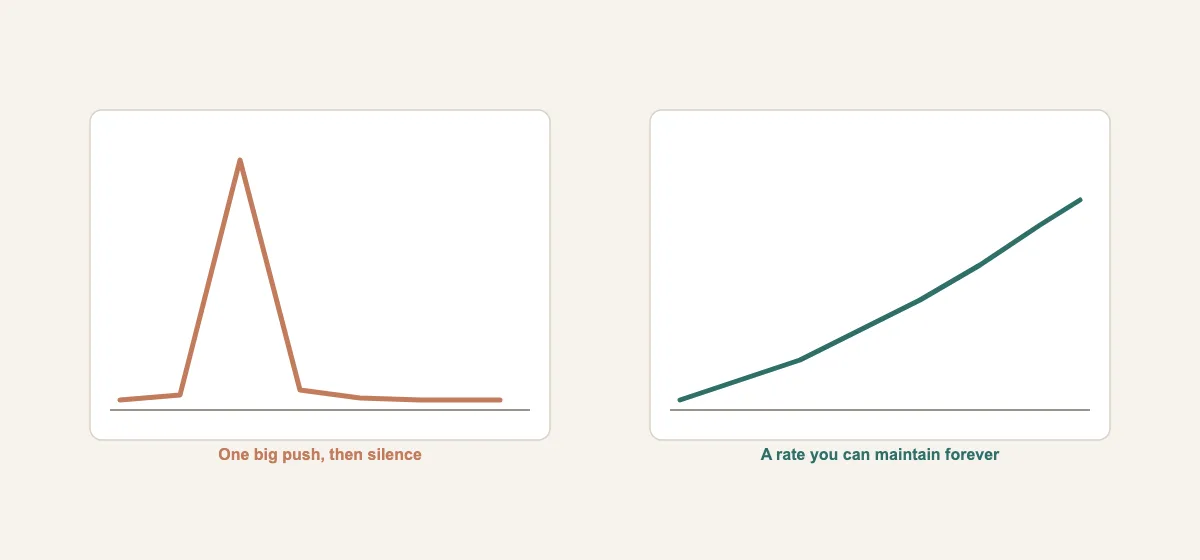
The practical version of this: a steady trickle beats a big push. Ten reviews a month for a year is far more useful than 120 reviews in one quarter followed by silence. A burst also raises a manipulation flag, because clustered arrival times are one of the patterns automated systems look for.
If you are starting from a low base, resist the urge to catch up in a fortnight. Set a rate you can maintain forever and hit it. Boring wins here.
What changed in April 2026, and why your old process may now be a violation
This is the part most businesses have not caught up on.
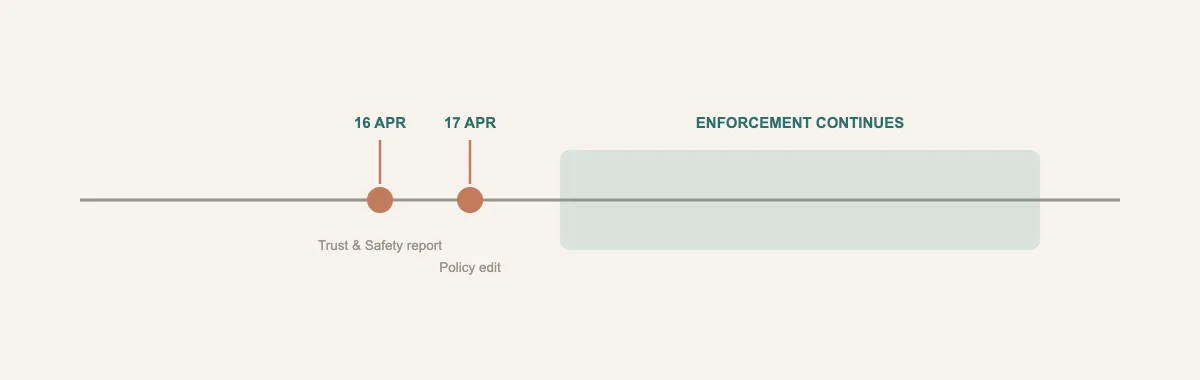
Two things happened within roughly 48 hours. On 16 April 2026, Google published its 2025 Trust and Safety Report along with a set of new Maps protections, including systems aimed at catching review extortion before reviews go live and faster filtering of suspicious place edits. The report stated that Google blocked or removed more than 292 million policy violating reviews during 2025.
The next day, 17 April 2026, the Maps user generated content policy page itself was edited. Two new clauses appeared under the Rating Manipulation section. Both target what businesses ask their own staff and customers to do.
The practices now explicitly named:
- Review quotas for staff. Telling your team to collect a set number of reviews per week is out.
- Asking customers to name a staff member. The "please mention Sarah by name" request, which service businesses have used for years to run internal incentives, is now called out directly.
Those sit alongside rules that were already in force and are being enforced harder: no incentives in exchange for reviews, no gating (asking happy customers for a public review while routing unhappy ones to a private form), no reviews from staff or family, and no pressuring people to review while they are still on your premises.
That last one catches more businesses than you would think. The tablet at reception. The kiosk in the waiting room. The "would you mind leaving us a quick review before you go?" at the till. Shared device patterns are visible in the data, and clinics and salons in particular built entire processes around them.
The enforcement side is automated and it is pattern based. Similar phrasing across multiple reviews, arrival times minutes apart, accounts with no history, and staff name mentions at a rate that is statistically odd for your category are all detectable without anyone filing a complaint.
If you are in the United States, there is a second layer. The FTC's rule on fake and deceptive reviews carries its own consequences that have nothing to do with rankings.
What a compliant ask looks like now
The safe version is duller than what most businesses were doing, and it works.
- Send the request after the customer has left, not while they are standing there.
- Use your own device or system, not a shared one, so the ask goes to their phone.
- Ask for honest feedback about their experience. Do not suggest a rating, a topic, or a name.
- Send it to everyone, not just the people you think are happy. Selective asking is gating.
- Time it to the moment the value landed. For a repair, that is same day. For a service with a delayed result, wait until the result is visible.
- Vary who sends it and when, so arrival patterns look like real life.
The one legitimate lever you keep is who you ask. Asking every customer across every service line, rather than just the easy wins, is fully compliant and it is what closes the attribute gaps described earlier.
Responses are first party content, and most are wasted
Every response you write is text you control, published on a property Google owns, attached to a customer statement about your business. That is unusual and undervalued.
Most responses read like this: "Thank you for your kind words! We appreciate your business." That sentence contains no information. It adds nothing for a future reader and nothing for a system parsing the page.
A better response confirms the specifics without inventing them:
> "Glad the new consumer unit is working well. Rewires in older terraced houses often turn up surprises behind the plaster, so thanks for being patient while we worked around the original wiring."
That reply names a service, a property type, and a real constraint of the job. It reads as written by someone who was there, because someone was. A prospect reading it three months later learns something. So does anything summarising the page.
Two practical rules I hold to:
Respond to everything, fast. Response rate and speed both matter to readers evaluating you, and a profile where every review has a same week reply reads as an operating business. Aim for 48 hours.
Handle negatives factually and briefly. Do not argue. Do not repeat the accusation. State what happened, what you did, and how to reach you. Two or three sentences. Long defensive replies convince nobody and they are the first thing prospects read.
Fake and unfair reviews: what removal actually looks like
The honest answer is that removal is inconsistent, and expectations should be set accordingly.
Reviews that clearly violate policy (spam, off topic content, profanity, conflicts of interest, obvious competitor attacks) have a reasonable chance of removal when reported through the profile's reporting flow. Reviews that are simply unfair, inaccurate, or written by someone with a grudge but no policy breach usually stay.
What I do:
- Report it once through the proper flow, with the specific policy it breaches identified.
- Log the date and the outcome.
- Reply publicly in the meantime, calmly and short, because that reply is what prospects will read whether or not the review is removed.
- If it is part of a coordinated pattern (several arriving together, all one star, all from accounts with no history), document the pattern before reporting, since a pattern is easier to act on than a single review.
Do not respond by buying reviews to dilute it. That is the fastest route to a review purge or worse, and review related profile suspensions are a real outcome, not a theoretical one.
Reviews beyond Google
Google is where the ranking effect concentrates, but it is not the only place review text gets read.
Industry specific platforms, your listings across other directories, and your own site all carry review content that gets crawled and cited. When someone asks an AI assistant for a local recommendation, the answer is often assembled from several sources that agree with each other. A business with a strong Google profile and nothing anywhere else looks thinner in that context than one with consistent signals across three or four platforms. This overlaps with how AI assistants pull local business data, which is worth understanding separately.
Adding review markup to your own site is worth doing where the reviews are genuinely first party and collected on your own property. Do not mark up your Google reviews as if they were yours. That is a misuse of the markup and it will not help.
A review programme is an operations problem wearing a marketing costume. The ask has to fit into how your team already works, or it stops within a month. If you want a review process built around your actual service mix, and a profile that reflects everything you sell rather than just your easiest job, that is part of what I do at rohanalvi.com.
Frequently Asked Questions
How many Google reviews do I need to rank in the local pack? There is no threshold number. What matters more is whether your review count and recency are competitive against the businesses currently ranking for your target query in your area. Check the top three results, note their counts and their newest review dates, and set your target from that rather than from a generic benchmark.
Can I still ask customers for reviews in 2026? Yes. You can ask, send a link, print a QR code, and follow up. What you cannot do is offer an incentive, tell people what to write, ask them to name a staff member, set review quotas for your team, ask only your happy customers, or pressure anyone to review on your premises.
Is asking a customer to mention an employee really banned? Requesting it is. Google added that clause to the Rating Manipulation policy in April 2026. A customer who spontaneously names someone is writing a normal review. The violation is on the merchant side, in the asking.
Do review responses affect rankings? Responses are best understood as content and conversion work rather than a direct ranking lever. They give future readers real information and they signal an actively managed profile. The measurable effect usually shows up in contact actions rather than position.
How do I get a fake review removed? Report it once through the profile's review reporting flow and name the specific policy it breaches. Removal is not guaranteed. Reply publicly in the meantime, since that reply is visible to every prospect regardless of the outcome.
Should I use a review management platform? It helps if it removes friction from sending requests after every job. Check that its default templates do not do anything now prohibited, since several older platforms shipped gating flows and staff name prompts as standard features. Audit the templates before you switch it on.