Local Landing Pages That Don't Read Like Doorway Pages
There is a page type every local business eventually builds, and almost everyone builds it badly.
You know the one. "Emergency Plumbing in Bolton." Then the same page again with Bolton swapped for Bury. Then Rochdale. Then Oldham. Same four hundred words, same stock photo of a wrench, same three testimonials. Someone once told the owner this was how you cover a service area.
I want to make the case for these pages anyway, because the data says they matter enormously, while being honest about why most of them fail.
In Whitespark's 2026 Local Search Ranking Factors survey, "dedicated page for each service" ranked as the number one factor for local organic visibility out of 187 signals. "Geographic keyword relevance of content" came second. The page type is not the problem. The execution is.
The rule I use before building anything
Before I create a page, I run one test. I borrowed the shape of this idea from semantic SEO work on query templates, and I have not found a better filter.
A query deserves its own page when two things are true.
- There is real, distinct search demand for it.
- The answer would be meaningfully different from the answer on a page I already have.
Point two is the one people skip. If your boiler repair Bolton page would say the same things as your boiler repair Bury page except for the place name, then the second page does not deserve to exist. It is not a new answer. It is a find and replace.
This is what search quality guidelines describe as a doorway page, meaning a page built for an index rather than for a person who actually lives in Bury.
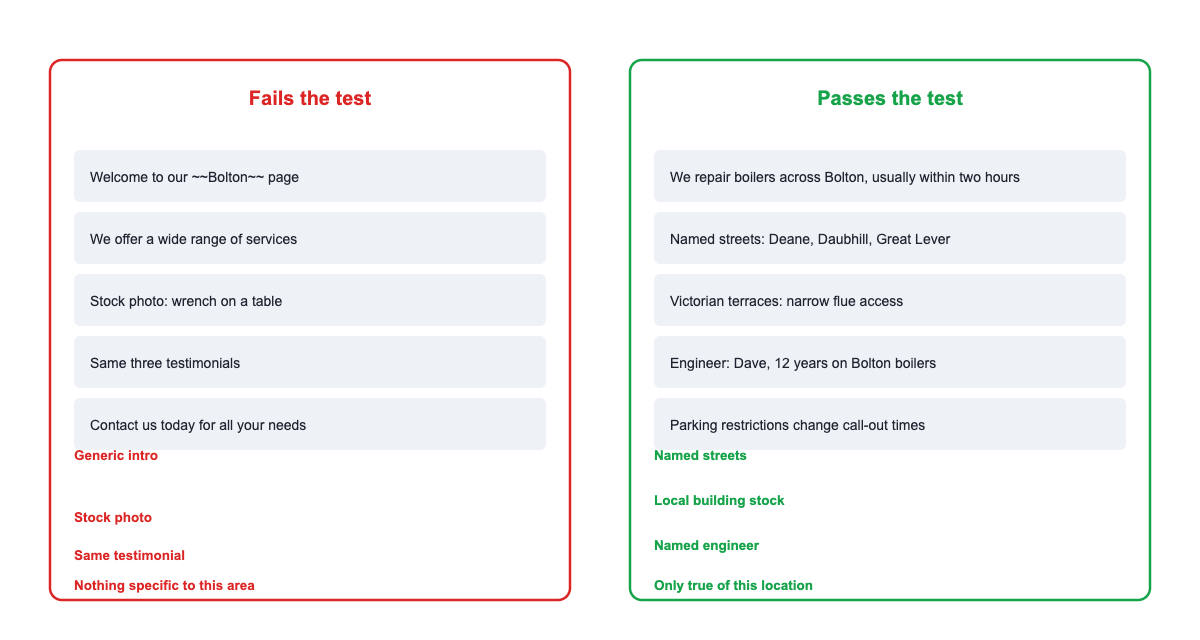
Flip it around, though. If a page can say something a swap-the-name template cannot, such as the Victorian terraces in one area with a specific pipework problem, the parking restrictions that change your call-out time, or the fact that one district is served by a different water authority, then the answer genuinely differs and the page has earned its slot.
My working threshold is this. If I cannot write three sentences that are true only of that location, I do not build the page. I write a section on a parent page instead and link to it. That threshold has killed more page ideas than it has approved, and site performance has been better for it.
The matrix, and how to cut it down
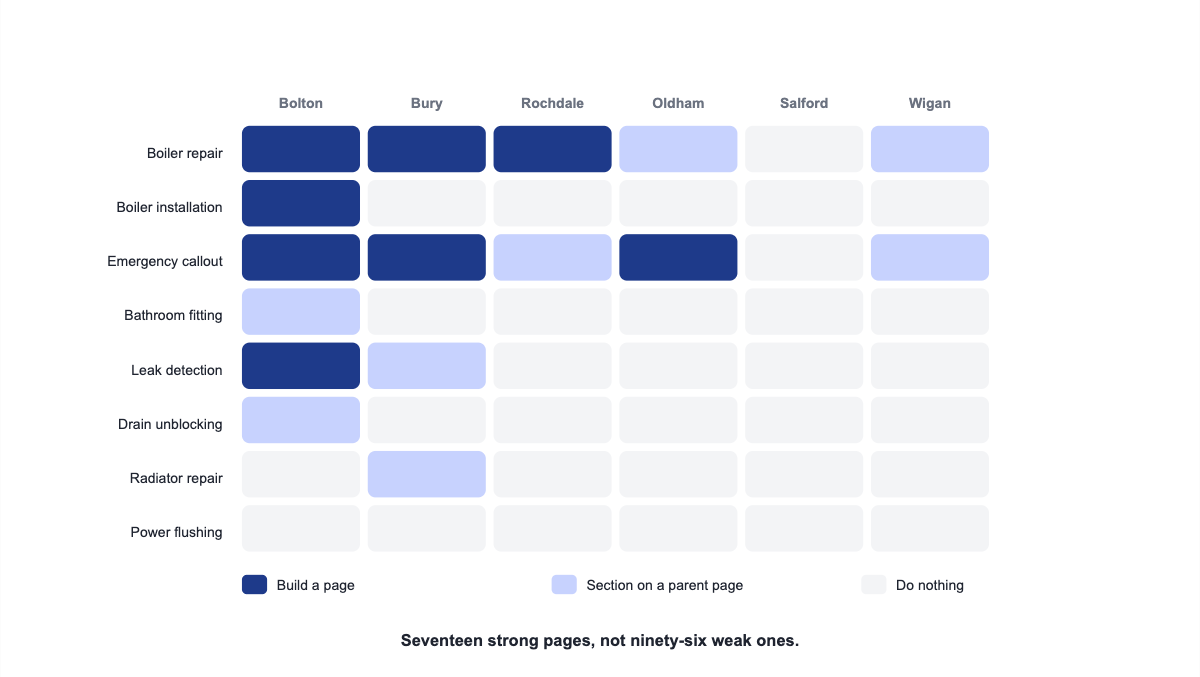
Most local businesses have two axes: services and locations. Multiply them and you get a matrix. A plumber with eight services and twelve suburbs has ninety-six theoretical pages.
Nobody should build ninety-six pages.
Here is how I reduce it.
Start with services rather than locations. Services are your revenue lines and they map directly to what people search. Give every real service a page. This is the number one local organic factor, so this is where the effort goes first. Let your categories decide which pages exist, because every category and predefined service on your profile should have a page waiting behind it.
Then add location pages only where you have a real presence or a real difference. A physical location always gets a page. A suburb where you do 40% of your jobs, and where you can name streets, building types and local quirks, gets a page. A suburb you visited twice gets a mention on a parent page.
Then build hybrids sparingly. Service plus city pages should exist only for your highest value combinations, meaning the ones where you would happily spend an hour writing something genuinely specific.
A realistic output for that plumber is around eight service pages, three or four location pages, and maybe five service plus city pages. Seventeen strong pages instead of ninety-six weak ones.
There is a good reason to keep the number down beyond quality. "Website's degree of focus on a specific niche" ranked ninth for local organic in the 2026 survey. Every thin page you add dilutes that focus. In NLP terms you are spreading entity salience across more documents than your topic can support, and each document ends up making a weaker claim about what your site is actually about.
What actually goes on the page
Let me be specific, because vague advice here is useless.
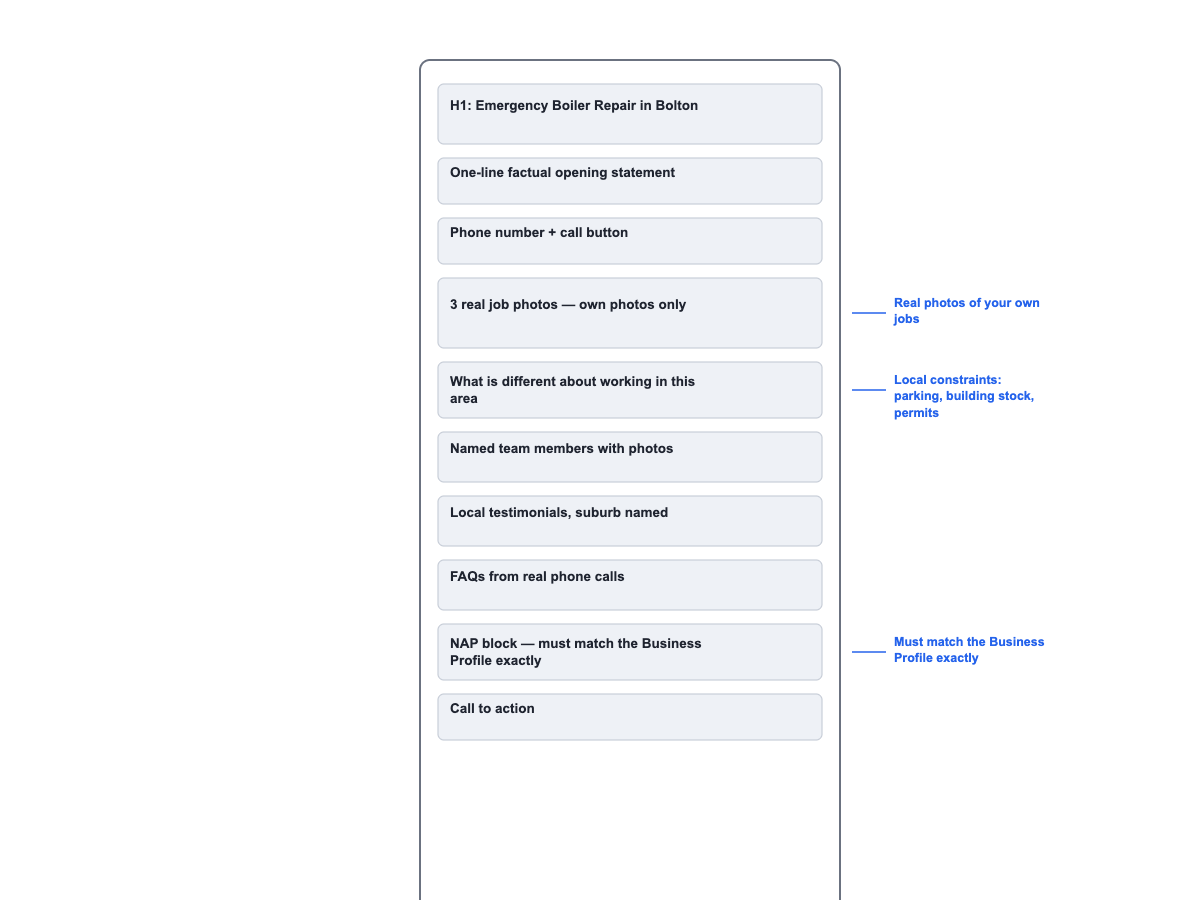
A heading that matches the query rather than a slogan. "Emergency Boiler Repair in Bolton" beats "Your Local Heating Heroes." I know which one reads better on a brochure. I also know which one a search system can classify.
A first paragraph that states the fact plainly. I write the opening sentence as a clean subject, predicate and object statement. For example: "We repair boilers across Bolton, usually within two hours of your call." That structure is a semantic triple in NLP terms, easy for a machine to extract and easy for a person to read. Darren Shaw made the same recommendation for directory descriptions in the 2026 report, and it applies just as well here. Do not open with a paragraph about today's fast-paced world.
Proof that you have physically been there. Real photos of your own vans, jobs and team. The 2026 data flags stock imagery and AI generated photos as quality problems on profiles, and the same logic applies to pages. Name streets, districts, landmarks and neighbouring areas. These are location entities, and their co-occurrence with your service terms is a large part of how a system decides your page is genuinely about that place.
Local constraints that shape the work. This is where most competitors give up, and it is where the page becomes unfakeable. Parking rules. Building stock and its typical faults. Council permits. Typical travel time from your depot. Water hardness. Conservation area restrictions. Someone who lives there will recognise these instantly, and no template can generate them.
Named people. Who does this work. A photo and a first name outperforms "our team of experts."
Local proof rather than general proof. Testimonials from that area with the suburb named. Job counts. Before and after photos from those postcodes.
Consistent NAP, and the right one. If a location page maps to a specific branch, it should carry that branch's name, address and phone exactly as they appear on the Business Profile. HTML NAP matching profile NAP ranked fifteenth for the pack. Mismatches here are one of the most common and most avoidable errors I find, and I go deeper on it in keeping your NAP consistent across sources.
FAQs that answer real questions. Not five invented questions to trigger a rich result. Ask your office staff what people actually phone up and ask about that area.
One clear conversion path. Phone number visible without scrolling, especially on mobile.
Length: shorter than you think
Here is a finding people found uncomfortable in the 2026 report. "Volume of quality content on service pages" dropped forty positions on the local pack factor list. Darren Shaw's commentary was blunt. Nobody wants ten thousand words about your grandmother's apple pie before they get to the recipe.
I agree, and I would go further. Long local pages are usually long because they are padded, and padding is what makes location pages read as templates in the first place. All that generic "why choose us" filler is exactly the text that stays identical across twelve city pages.
Cut the generic and keep the specific, and your page gets shorter and better at the same time. Six hundred to nine hundred words of genuinely local content beats two thousand words of scaffolding. It also happens to be the format AI systems extract from more cleanly, which I cover in how AI systems pull answers out of a page.
Structure and internal links
Two factors from the 2026 organic list matter here. Internal linking across the entire website ranked sixth, and proper site architecture organised into topic areas ranked twenty-first. Keywords in the anchor text of internal links ranked nineteenth.
That combination tells you something concrete. These pages should not be a flat pile of URLs sitting under /locations/.
The structure I use looks like this.
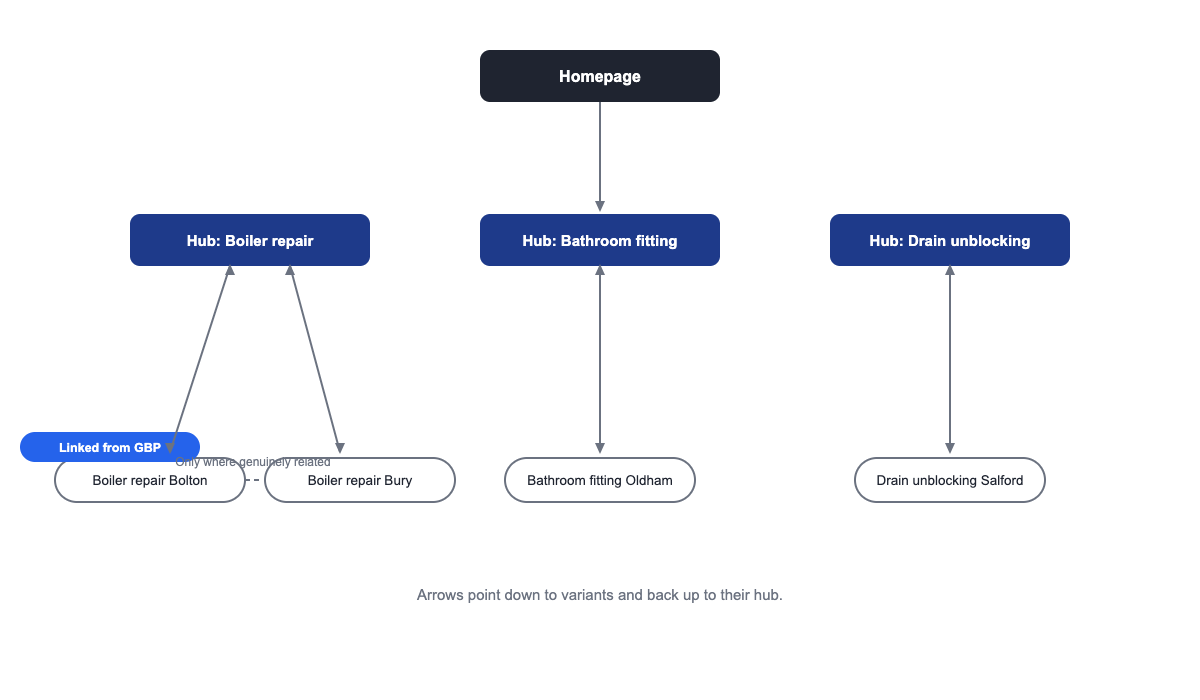
Service hub pages describe what you do in general, and link down to their location variants.
Location pages link back up to the relevant service hubs, and sideways to genuinely adjacent areas rather than to all eleven others.
The page linked from your Business Profile gets internal links pointing to it from across the site. That factor ranked forty-fourth for the pack. Links from that page out to others dropped sharply in importance, all the way to 109, so point links at it and stop worrying much about what it points at.
On anchor text, use descriptive phrases people would actually say. "Emergency boiler repair in Bolton" works. "Click here" does not. Neither does the same anchor eleven times. Varying anchors keeps the contextual signal diverse rather than looking automated.
For URLs I default to /services/boiler-repair/ for the hub and /boiler-repair-bolton/ or /services/boiler-repair/bolton/ for the variant. Either works. Consistency matters more than the shape.
How to tell if your existing pages are doorway pages
Run this on your own site. It takes fifteen minutes and it is uncomfortable.
- Open two of your city pages side by side.
- Delete every instance of the city name from both.
- Read them.
If you cannot tell which page is which, you have doorway pages. Not pages that need improving. Doorway pages, in the sense the guidelines describe.
Second test: search a distinctive sentence from one of the pages in quotes. If it appears on multiple URLs of your own site, you are competing with yourself.
Third test: check Search Console for those pages. If a group of location pages all collect impressions but almost no clicks, and their positions hover in the twenties, Google has crawled them, treated them as near duplicates, and picked one to represent the set. That is what near duplicate handling looks like from the outside.
What I do with pages that fail the test
Not always delete. Here are the options in order of how often I use them.
Merge. Fold six thin city pages into one strong regional page with genuine sections for each area, then redirect the old URLs. This is my default.
Rewrite the top three. Keep the pages that map to real revenue, make them genuinely specific, and redirect the rest into them.
Delete and redirect. For pages covering areas the business does not really serve. Removing them helps your niche focus rather than hurting it.
Leave and improve on a schedule. Only when the pages already get meaningful impressions and just need substance added.
I ran this exercise for a regional flooring company with thirty-one location pages. We merged them into nine. Total organic sessions did not drop, and enquiries from the merged pages went up, because the nine survivors were pages a human being would actually read and trust.
Where this connects to the map pack
Local landing pages influence local organic rankings powerfully. Their effect on the map pack is real but smaller, since the dedicated-page factor ranked twenty-fourth there rather than first.
That distinction matters when you are setting expectations. If a client's problem is that they do not appear in the three-pack, a landing page programme is not the fastest fix. Profile side work is. That is the order of operations I lay out in the diagnostic order I use on map pack problems.
Landing pages are how you win the results below the pack, how you cover queries where no pack appears at all, and how you build the corroboration that makes your profile's claims credible. That is worth doing properly. It is just not the emergency lever.
Frequently asked questions
How many location pages should I create? As many as pass the three sentence test, meaning you can write three sentences that are true only of that location. For most single location businesses that is one to three pages. For genuine multi-branch operations, one per branch, always.
Are city pages against Google's guidelines? No. Near duplicate city pages built purely to catch search traffic are. A page with genuine local information, real proof and a real reason to exist is a normal, useful page.
Should each page have its own phone number? Each physical location should show its own number, matching that branch's Business Profile. A single location business serving several towns should show one consistent number everywhere. Inventing area-code numbers per suburb creates inconsistency across your sources for no benefit.
Do I need schema markup on these pages? It is worth adding LocalBusiness markup for real locations, but keep expectations calibrated. Schema markup ranked low on the 2026 pack factor list. It helps machines parse what is already on the page. It does not substitute for the page being good.
What if two of my locations are close together? Write honestly about what differs, such as the team, opening hours, parking and services offered at each. If nothing differs except the address, one page describing both is more useful than two pages competing with each other.
How often should these pages be updated? Freshness of content on service pages ranked mid table for organic and low for the pack, so this is not urgent. I refresh when something real changes: new team members, new services, new job photos, changed hours. Rotating the date without changing the content fools nobody.
If you are staring at a spreadsheet of forty planned city pages and quietly suspecting most of them should not exist, that is usually the right instinct. Working out which ones deserve to be built, and what to put on them, is a large part of what I do at rohanalvi.com.