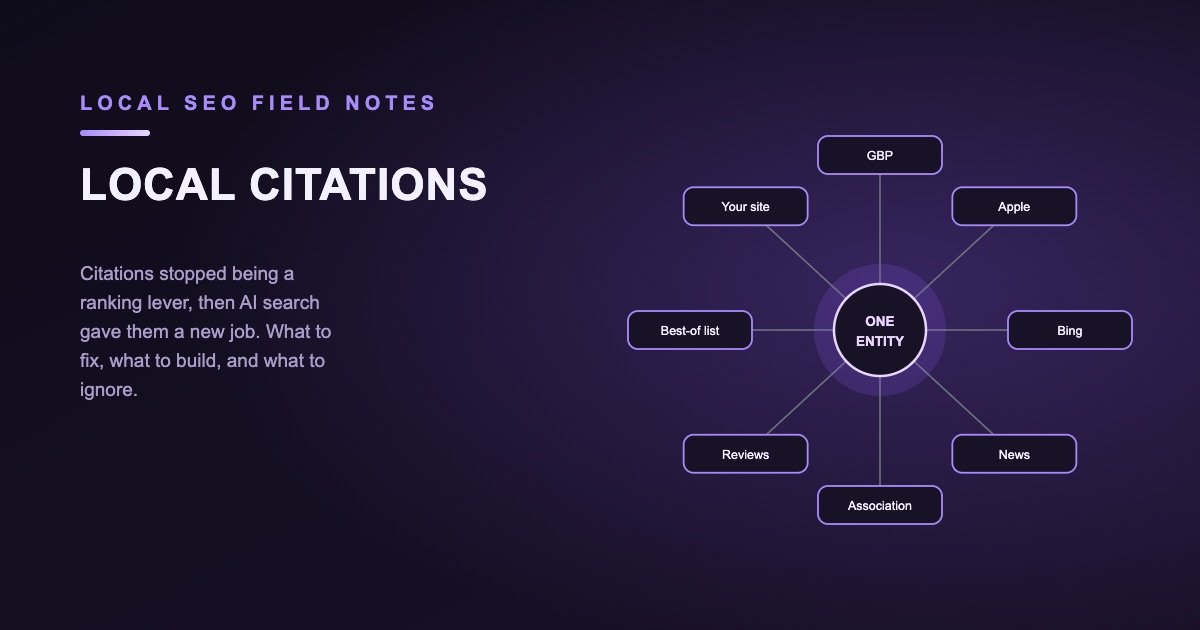
Local Citations in 2026: What to Fix, What to Build, and What to Ignore
I have a slightly awkward relationship with citations.
For about a decade, the honest answer to "should I buy 200 citations?" has been no. Citation signals have been quietly sliding down the weighting charts in every edition of Whitespark's Local Search Ranking Factors report, and the 2026 edition continued the trend. The citation group lost weight again.
Then the same report dropped a line that made me rethink the whole category. Three of the top five AI search visibility factors are citation factors. Darren Shaw's summary of it was that in AI SEO, mentions are the new link.
So citations did not die. They changed jobs.
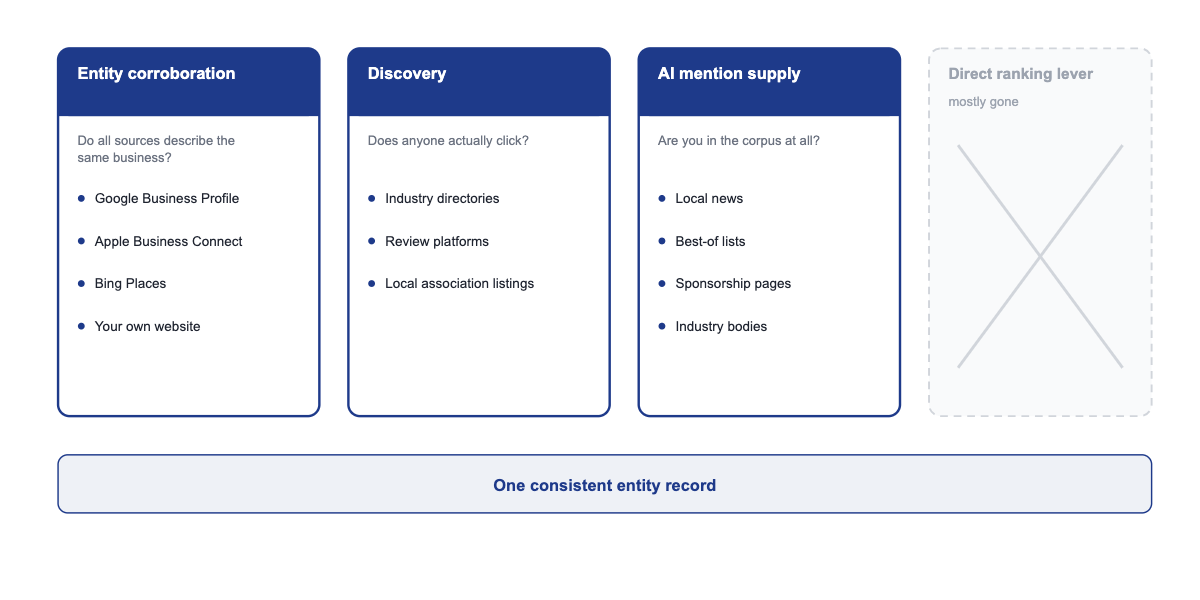
The three jobs a citation actually does
This is the framework I use with clients, because "citations help you rank" is too vague to act on.
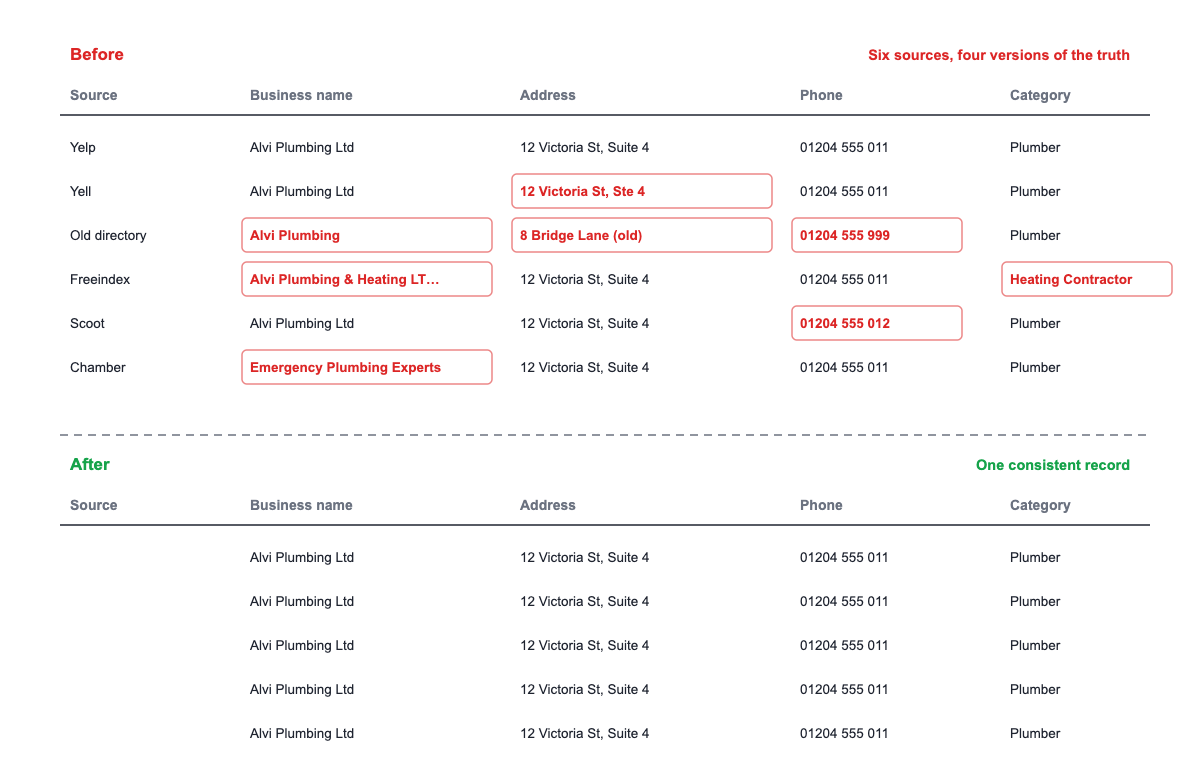
Job one is entity corroboration. Every source that lists your business is a statement about a real world entity. Google, and every other retrieval system, has to work out whether all those statements describe the same business. Deciding that "Alvi Plumbing Ltd" on one site and "Alvi Plumbing" on another are one entity rather than two is called entity resolution. Consistent data makes it easy. Conflicting data makes it hard, and a system that is uncertain about your identity tends to be conservative about surfacing you.
Job two is discovery. Some directories still send actual humans. Not many. But in some industries, including legal, home services and healthcare, the industry specific ones genuinely convert.
Job three is mention supply for AI systems. This is the new one. Language models were trained on, and increasingly retrieve from, a broad crawl of the open web. If your business is mentioned across many independent sources, you exist in that corpus. If you are only on your own website and Google Maps, you barely do.
Most citation packages sold today are still priced as though there is a fourth job, a direct ranking lever, that mostly stopped existing years ago.
What the 2026 data actually says
I want to be precise here, because the nuance is where the strategy lives.
Looking at the local pack factor list:
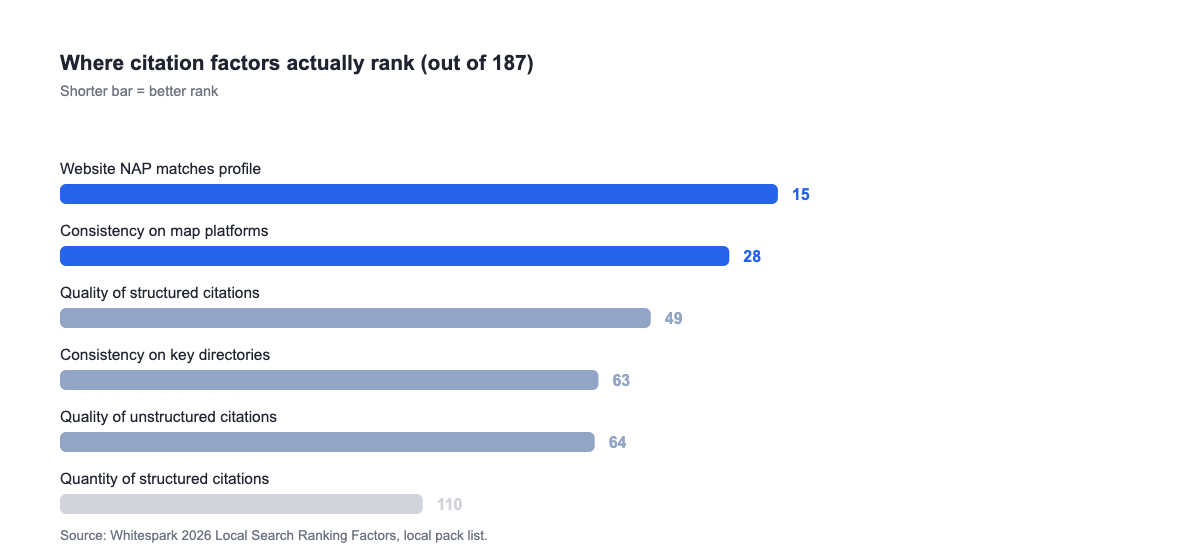
- Consistency of citations on the primary map platforms, meaning Google Maps, Bing Maps and Apple Maps, ranked twenty-eighth. That is the highest placed citation factor by a distance.
- Quality and authority of structured citations ranked forty-ninth.
- Consistency on key sites, meaning the big directories, ranked sixty-third.
- Quality and authority of unstructured citations, meaning newspaper articles, blog posts, government sites and industry associations, ranked sixty-fourth.
- Consistency on data aggregators ranked eighty-fifth.
- Quantity of structured citations, the thing citation packages actually sell, ranked one hundred and tenth out of 187.
Read those in order and the instruction is hard to miss. Quality beats quantity by roughly sixty places. Consistency beats volume. Map platforms beat directories. Editorial mentions beat listings.
Meanwhile "HTML NAP matching GBP NAP", meaning your own website agreeing with your own profile, ranked fifteenth. Your website is the cheapest and highest value citation you will ever fix, and it is free.
The tier system I use
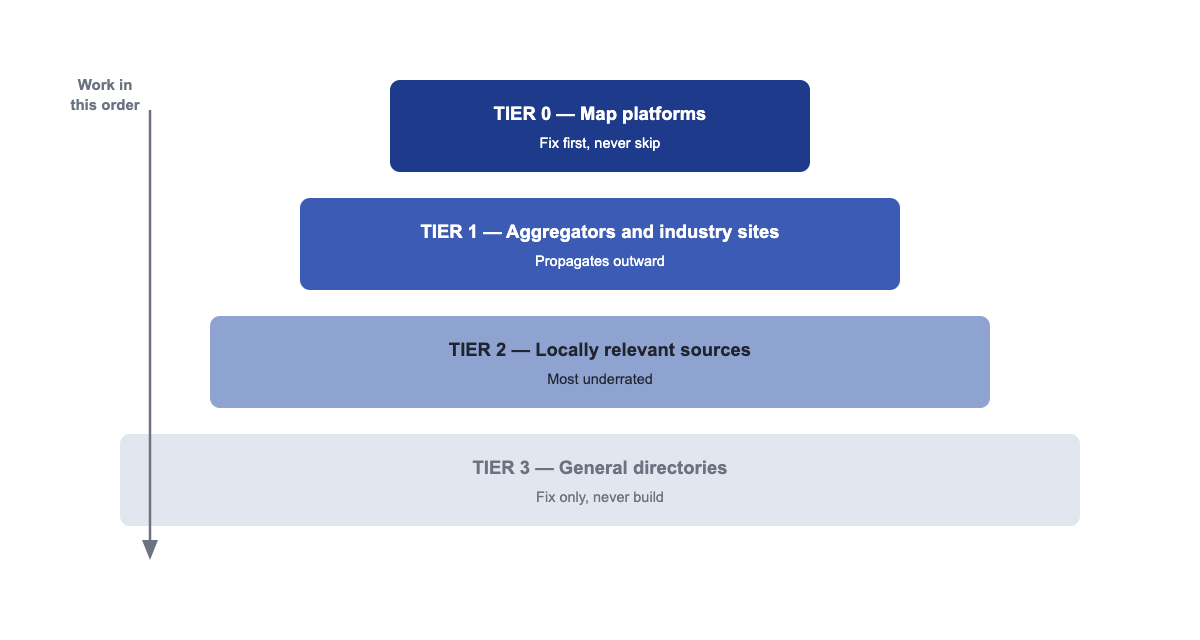
I sort every possible citation source into four tiers and work top down. I do not touch tier three until tiers zero through two are clean.
Tier 0: the map platforms. Google Business Profile, Apple Business Connect, Bing Places. These are not directories. They are the systems that actually serve local results across the devices your customers use. Every field filled, every detail matching. This tier is non-negotiable and it is where the highest ranked citation factor lives.
Tier 1: aggregators and the two or three sites that define your industry. The data aggregators feed a long tail of smaller directories, so a correct record here propagates outward. Alongside them sits whatever site dominates your specific industry, such as a legal directory, a trades body or a healthcare listing platform. In some verticals a single industry site outperforms fifty generic ones.
Tier 2: locally relevant sources. Chamber of commerce, local business associations, sponsorship pages from the club you fund, the local newspaper's business listing, the council supplier register, the university's local vendor page. These are where structured and unstructured citations overlap, and they are the most underrated tier by a wide margin. Quantity of citations from locally relevant domains ranked sixty-ninth for the pack and forty-ninth for organic, well above generic directory volume.
Tier 3: everything else. The long tail of general directories. My rule is that I do not build these, I only fix them. If an old listing carries your previous address, correct it or remove it. Otherwise leave it alone and spend the time elsewhere.
Audit before you build, always
This is the piece of advice in this article that saves the most money.
Building new citations on top of inconsistent existing data is like adding rooms to a house with a cracked foundation. You have not fixed the identity problem. You have made it larger and harder to untangle.
Here is the audit I run.
1. Fix the canonical record first. Decide the exact format for your name, address and phone number. Not roughly, exactly. Suite 4 or Ste 4. Street or St. Ltd or Limited. Write it down. This becomes the reference every other listing is checked against.
Your legal, real world business name goes here, not the keyword stuffed version. Keyword stuffing the business name ranked as a top suspension risk in the 2026 data, and I have seen more profiles suspended for that than for anything else.
2. Search for yourself in ways that surface old records. Search your phone number in quotes. Search your previous address. Search old brand names and misspellings. This is how you find listings you forgot existed, including the ones created by a marketing agency you fired in 2019.
3. Log every discrepancy in one sheet. Source, URL, what it says, what it should say, how to change it, and whether you have login access.
4. Hunt duplicates on the map platforms specifically. Duplicate profiles split your signals in half and confuse entity resolution more than any wrong phone number. Duplicates usually come from a moved office, an old agency, or a second profile someone created for a department. Get them merged or suppressed. This is tedious, and it is the highest value hour in the whole audit.
5. Correct in order: tier 0, then tier 1, then tier 2. Wrong data outranks missing data as a problem. Fix before you add.
Only after all that do I look at building anything new.
Rented listings and owned listings
Here is something the sync platforms do not put in the brochure.
Managed listing services keep hundreds of directory records aligned for a monthly fee, which is genuinely useful for multi-location brands. But many of those listings exist because you are paying. Stop paying, and some revert to whatever data the platform held before, or vanish entirely. You were renting.
Listings you created yourself, with your own login, are owned. They persist.
For a single location business I lean toward owned. Fewer listings, permanent, and you control them. For a fifty location brand the maths flips, because the labour of manual management outweighs the rental risk and sync tools become the right call.
Either way, keep your own logins for tier 0 and tier 1. Never let an agency hold the only access to your Business Profile. I have spent whole weeks recovering profiles from unresponsive former agencies, and it is a miserable way to spend a client's budget.
The unstructured half is where the value moved
If I get a limited budget for citation work now, I spend it here.
Unstructured citations are mentions in editorial content rather than listing fields, such as a local news article, an industry association member spotlight, a supplier page, or a blog post about a community event. They scored roughly equal to good structured citations in the pack data, and considerably higher for local organic.
More importantly, they are what AI systems actually retrieve. Ahrefs' analysis of 75,000 brands found branded web mentions correlated with AI Overview brand visibility at around 0.66, while backlinks came in around 0.22. Mentions, not links. A brand mentioned widely across the web gets recommended by AI systems far more often than a brand with a good backlink profile and thin coverage.
How I generate them, in rough order of effort:
- Sponsor something local that publishes a supplier or partner page.
- Get onto industry association member directories with a real profile rather than a stub.
- Offer genuine commentary to local press, because local journalists need quotable people constantly.
- Join the best-of and expert curated lists in your area. Darren Shaw specifically flagged these as an AI era priority in the 2026 report, and yes, getting on them usually means asking.
- Publish something worth referencing, such as local data, a survey of your area, or a genuinely useful guide.
None of this is fast. All of it compounds, and it is durable in a way a directory submission never was.
The description field nobody optimises
One small tactic worth stealing. On every directory listing that gives you a description field, write the first sentence as a clean factual statement of subject, action and object. For example: "Alvi Plumbing is an emergency plumbing company serving Bolton and the surrounding boroughs."
That structure is a semantic triple, and it is the easiest possible thing for an extraction system to parse. Darren Shaw recommended exactly this for directory descriptions in the 2026 report. Most businesses use that field for marketing copy that says nothing extractable.
While you are in there, check the category classification on each directory too. If Google has you as an emergency plumber and three directories have you as a general contractor, you have conflicting statements about your entity type. That is the same coherence problem I cover in keeping your category consistent across every source.
What I ignore
I want to be as clear about the "do not" as the "do".
Bulk submission packages. Two hundred directories nobody visits, built on data you have not audited yet.
Any service that changes your NAP to optimise it. Adding a keyword to your name across fifty directories manufactures inconsistency and suspension risk at the same time.
Chasing citation count as a KPI. Quantity of structured citations ranked 110th. If your report leads with citations built this month, the report is measuring the wrong thing.
Paying to fix a listing on a site with no traffic, no authority and no aggregator relationship. Delete it if you can. Otherwise leave it.
Citations are foundational work rather than growth work. They belong in the first month of an engagement and then in a quarterly check, not in an ongoing monthly line item. If you are trying to work out where they sit relative to everything else, I laid that out in where citations sit among the real ranking factors.
Frequently asked questions
How many citations do I need? There is no number. A clean, consistent presence on the three map platforms, the aggregators, your two or three industry sites and a handful of genuinely local sources beats two hundred generic listings, and the 2026 factor rankings back that up directly.
Does a small NAP difference actually hurt? Suite 4 versus Ste 4 is unlikely to hurt anything, since that level of variation is normal and systems handle it. Two different phone numbers, two different street addresses, or an old address still live somewhere are real problems, because they create genuinely conflicting statements about your identity.
Should I use a citation management service? For multi-location brands, usually yes, because the labour saving is real. For a single location, I would rather you build twenty owned listings once and keep the logins. Understand which listings you own and which you are renting before you commit.
Do citations help with ChatGPT and other AI assistants? This is where they have gained ground. Three of the top five AI search visibility factors in the 2026 survey were citation factors, and independent correlation work found web mentions to be one of the strongest signals for brand visibility in AI answers. There is more on this in mentions are how AI assistants find you.
What do I do about a duplicate listing I cannot claim? Report it through Maps as a duplicate and provide evidence of the real listing. It can take several attempts. It is still worth doing, because a duplicate is worse than a missing listing when it splits your reviews and your signals.
Does my website count as a citation? It is your most important one. Your own NAP matching your profile ranked fifteenth out of 187 factors for the pack. Put a consistent NAP block in the footer and on every location page, and treat it as the reference copy. I cover the details in the NAP block on your location pages.
Citation work is unglamorous, and it is the kind of thing that quietly holds everything else back when it is wrong. If you want the audit done once, properly, with the duplicates hunted down and the record set straight, that is part of how I start local projects at rohanalvi.com.